Mandarin, Vanilla & Warm-Spiced Galatopita
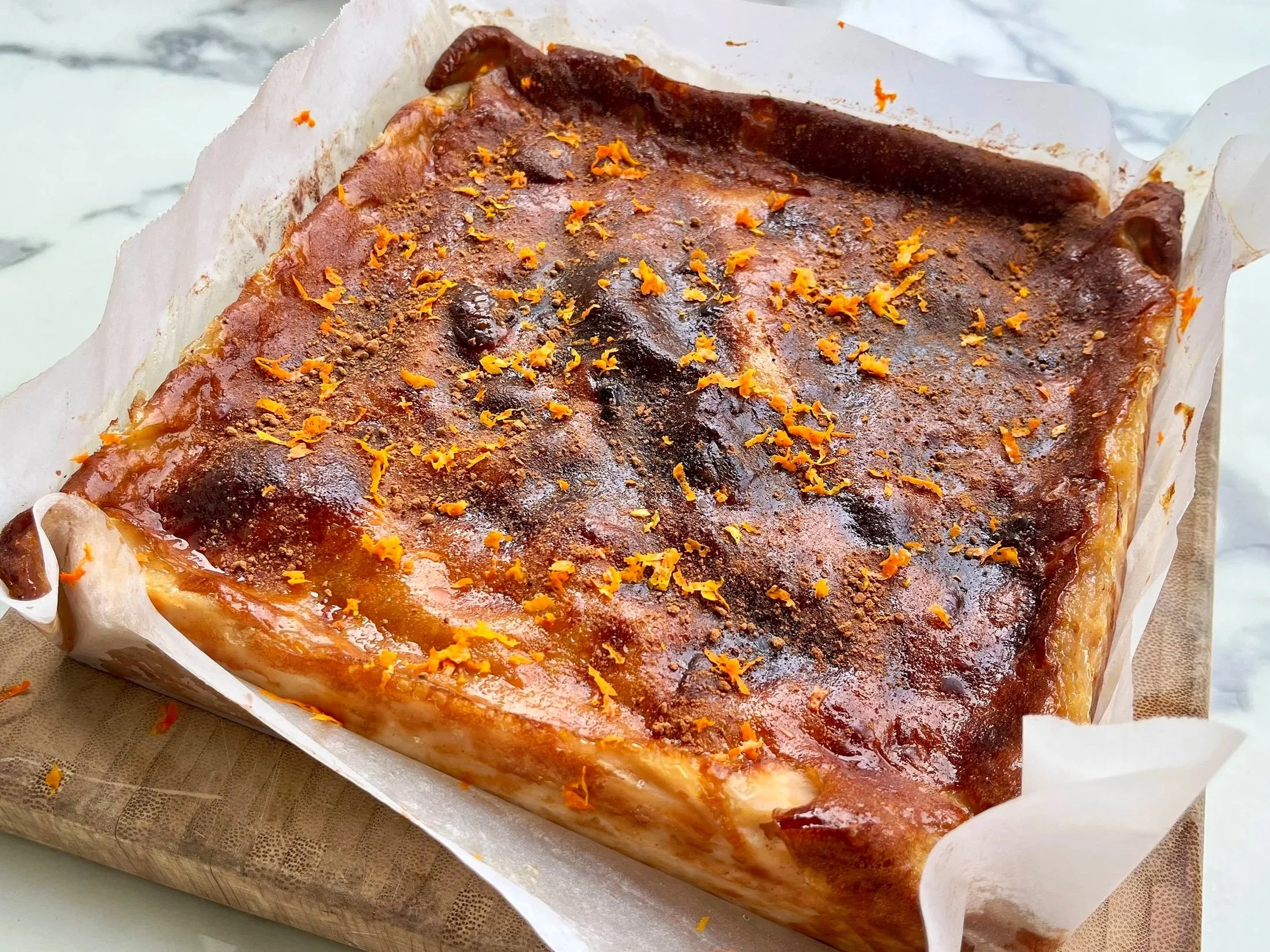
A silky baked milk custard with fragrant mandarin zest, vanilla bean and gentle warmth from cinnamon, cardamom and freshly grated nutmeg. Finished with a glossy cinnamon-sugar crust and fresh mandarin zest.
This recipe is adapted with enormous gratitude from the galatopita Elisa taught me at Villa Maria in Syros. The foundation belongs entirely to her; this is my warmly spiced, mandarin-scented version inspired by her beautiful original recipe.
Serves
Approximately 9 generous slabs
Equipment
20 cm square baking tin
Baking paper
Large, heavy-based saucepan
Very large heatproof mixing bowl
Whisk
Ladle
Fine grater or microplane
Small jug or bowl
Ingredients
For the milk custard
1.25 litres full-cream milk, divided into 1 litre and 250 ml
100 g caster sugar
100 g fine semolina
3 large eggs, at room temperature
50 g salted butter
1 tablespoon vanilla-bean paste
Finely grated zest of 2 mandarins
½ teaspoon ground cardamom
1 teaspoon cinnamon
A light grating of fresh nutmeg
¼ teaspoon fine salt
For the cinnamon-sugar top
50 g brown sugar
50 ml water
1 teaspoon ground cinnamon
To finish
Fresh mandarin zest
Method
1. Prepare the tin
Preheat the oven to 180°C fan-forced.
Line a 20 cm square baking tin with baking paper, leaving enough paper extending above the edges to help lift the galatopita from the tin later.
2. Prepare the egg mixture
Pour 250 ml of the milk into a very large heatproof bowl.
Add the eggs and whisk gently until combined.
Set the bowl beside the stove with your whisk and ladle ready.
3. Heat the remaining milk
Pour the remaining 1 litre of milk into a large, heavy-based saucepan.
Add the caster sugar, mandarin zest, vanilla-bean paste, cardamom, fresh nutmeg and salt.
Warm the mixture gently over low-to-medium heat, whisking regularly, until the sugar has completely dissolved and the milk is steaming.
It should be thoroughly hot but must not be bubbling or boiling.
4. Add the semolina
Gradually rain the semolina into the hot milk while whisking continuously.
Cook for another 3–4 minutes, continuing to whisk so the semolina remains smooth and does not settle or catch on the bottom of the saucepan.
The mixture may begin to thicken slightly, but it will not reach its final custard consistency yet.
5. Temper the eggs
Remove the saucepan from the heat.
Very slowly add one ladleful of the hot milk mixture to the bowl containing the eggs and cold milk, whisking continuously as you pour.
Continue adding the hot mixture one ladleful at a time, never stopping the whisk.
This part requires some coordination. If you have a handy sous chef, one person can ladle while the other whisks. It is completely manageable alone—I make it by myself—but it takes patience and a little practice.
Slower is considerably better than scrambling the eggs and having to start again.
Once approximately half of the hot mixture has been incorporated and the egg mixture feels thoroughly warm, you can begin pouring the remainder from the saucepan in a slow, controlled stream while continuing to whisk. You do not need to tediously ladle every last drop.
6. Thicken the custard
Pour the entire combined mixture back into the saucepan and return it to low-to-medium heat.
Whisk continuously until the custard becomes noticeably thick, smooth and more resistant beneath the whisk. This takes approximately 20 minutes, so settle in and be patient.
Pay attention to how the custard feels rather than relying exclusively on the clock. It will gradually become firmer and more difficult to whisk.
When you briefly pause the whisk, a small bubble may rise slowly to the surface and make a thick little dollop sound. That is the rather specific but extremely helpful sign that your custard is ready.
Remove it from the heat immediately and continue whisking for another moment to help release some of the residual heat.
7. Add the butter
Add the butter to the hot custard and whisk until it has completely melted and the mixture is smooth and glossy.
Pour the custard into the lined baking tin and gently smooth the surface.
Leave it to settle for a few minutes while you prepare the cinnamon-sugar topping. A delicate skin will begin forming across the surface—this is exactly what we want.
8. Make the cinnamon-sugar topping
Combine the brown sugar, water and cinnamon in a small jug or bowl.
Stir until the sugar is mostly dissolved, then gently pour the mixture over the settled custard. Pour slowly and distribute it across the surface rather than directing everything into one enthusiastic crater.
9. Bake
Bake for approximately 1 hour, or until a beautiful golden crust has formed across the top.
The edges should be set, but the centre should still wobble gently when the tin is moved. That wobble means there is a soft, creamy custard waiting underneath.
10. Cool and refrigerate
Remove the galatopita from the oven and allow it to cool completely to room temperature in the tin.
Do not cut it yet.
Once cool, transfer it to the refrigerator for at least 1 hour, preferably longer, so the custard can finish setting properly.
11. Slice and serve
Use the baking paper to carefully lift the chilled galatopita from the tin.
Slice it into nine thick, decadent slabs and finish with plenty of freshly grated mandarin zest.
Serve chilled or allow each slice to sit at room temperature for 10–15 minutes for a softer, creamier texture.
